What are the different types of usage models?
Last updated: August 26, 2026
Summary
Merchants utilize a range of usage-based pricing models to cater to customer needs and ensure fair value exchange. These models enable flexibility by aligning costs with consumption, fostering transparency and scalability. Tabs supports a wide variety of these models. In this article, we will break down how these models operate in Tabs.
When setting up usage, Tabs will extract the usage terms from the contract, including the product, rate, billing cadence and terms, and minimum/threshold terms (if applicable). Then, Tabs will ingest usage data to calculate the total charges, taking into account the specific usage model in the contract to ensure invoice totals are correct. Below, there is an explanation of each usage model as well as a diagram depicting how it works in Tabs.
Usage in Tabs can be split into two main categories: Pay-as-you-go and Committed consumption. Pay-as-you-go charges customers based on actual usage without any upfront commitment, while committed consumption requires customers to pre-commit to a specified usage level, often at a discounted rate. Additionally, Tabs supports outcome-based, prepaid, and hybrid models for more complex billing scenarios.
Pay-as-you-go
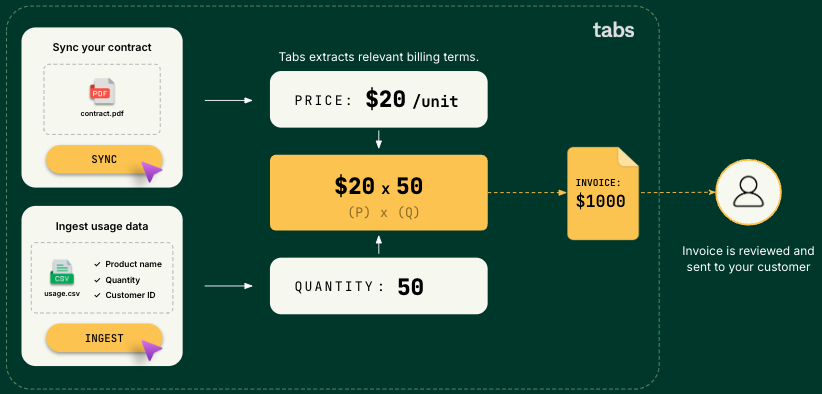
Unit pricing
Price is defined by contract
Quantity is defined by usage
Invoice = Price * Quantity
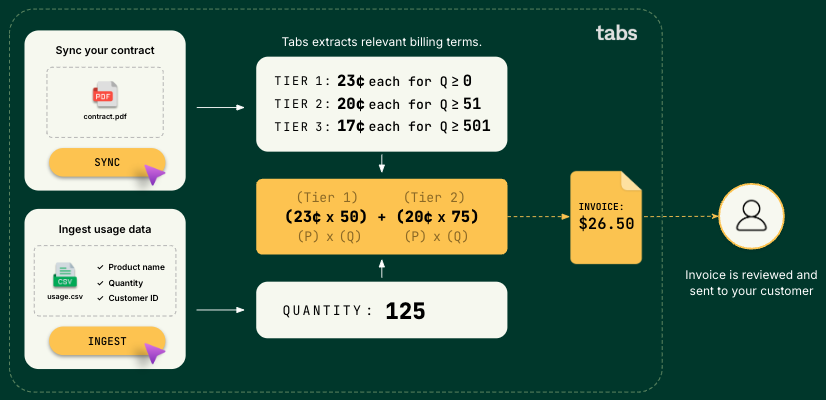
Graduated unit pricing
Price is defined in tiers and quantity will be apportioned across tiers
Quantity is defined by usage
Invoice =
Price1 * Quantity in tier 1 +
Price2 * Quantity in tier 2 +
Price3 * Quantity in tier 3 + …
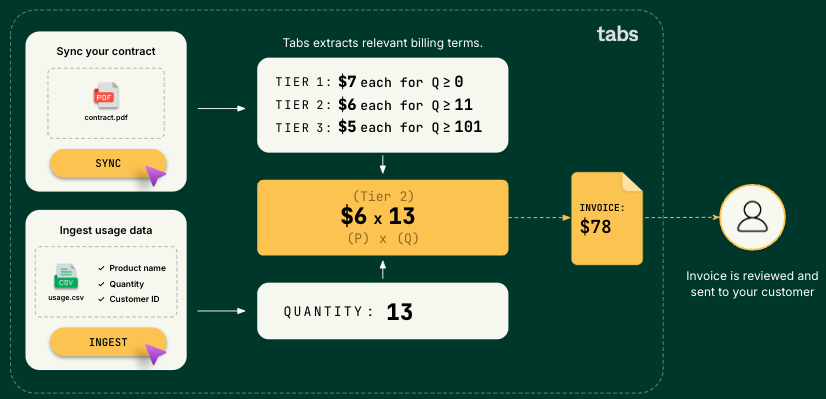
Volumetric unit pricing
Price is defined in tiers but all quantity will be billed at a single tier
Quantity is defined by usage
Invoice =
Price1 * Quantity if in in tier 1 OR
Price2 * Quantity if in tier 2 OR
Price3 * Quantity if in tier 3 …
Commit consumption
There are various types of commit consumption models, ranging from monthly to annual commits, to pay-as-you-go models vs. paying upfront. In Tabs, any time there is a committed amount, it is considered a commit consumption model because there is a contractual commitment to the amount of usage that needs to be consumed. These models can use any of the usage pricing models listed above.
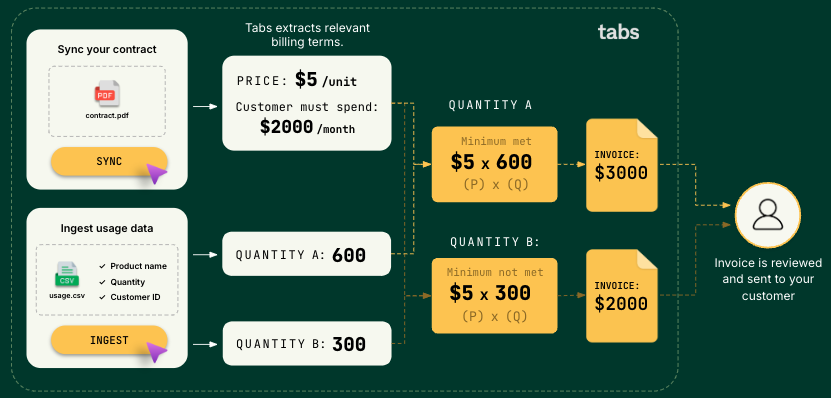
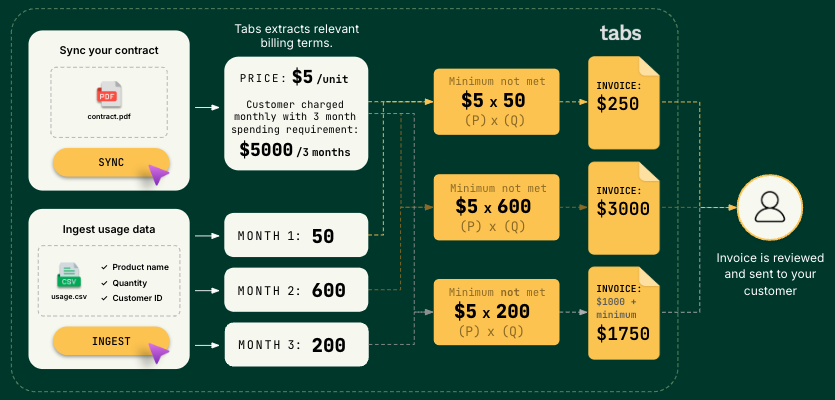
Monthly minimum, Pay-as-you-go
Minimum commitment that must be met on a monthly basis, which can be tracked per unit or per dollar amount
If the monthly minimum is met, that invoice reflects the total charges
If the monthly minimum is not met, then the invoice will have a true-up, which is an adjustment for the amount needed in order for to meet the minimum
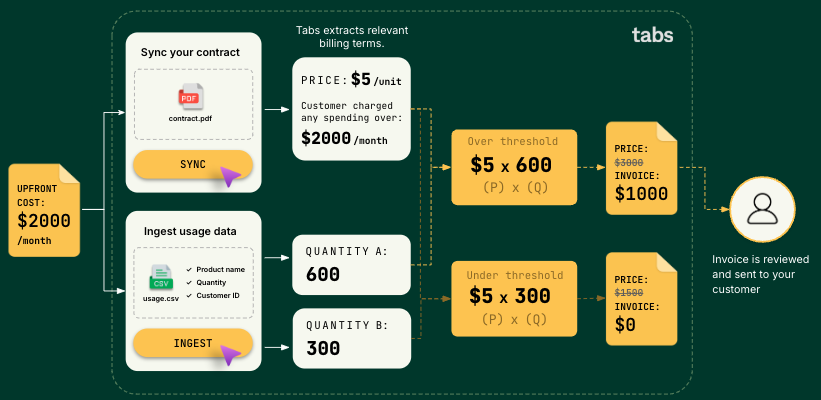
Monthly threshold, Up-front payment
Monthly commitment of allowable usage that is prepaid
If the monthly threshold is not met, there are no billing affects. This is the notion of "use it or lose it".
If the monthly threshold is surpassed, then overage charges might apply, resulting in mid-term invoices despite the prepayment
Service term minimum, Pay-as-you-go
Minimum commitment applies to a full service term (as opposed to an individual billing period, as in the example above)
Total usage cumulates over the length of the term, contributing the the committed amount
If the minimum is met at any point during the service term, then there are no invoice adjustments and invoices will reflect total usage charges
If the minimum is not met by the end of the service term, then the final invoice of the term will have a true-up
Service term threshold, Up-front payment
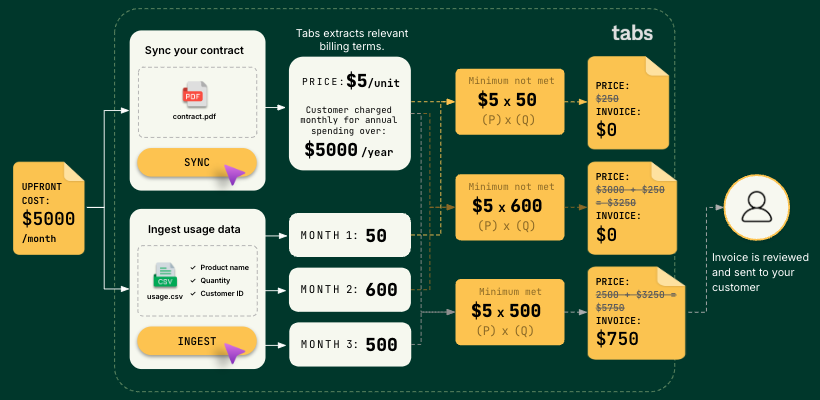
Minimum commitment applies to a full service term, and is prepaid
Total usage cumulates over the length of the term, contributing the the committed amount
If the threshold is not met by the end the service term, then there are no invoice adjustments, and any leftover allowable usage will like no unused
If the threshold is surpassed at any point during the service term, then overage charges might apply, resulting in mid-term invoices despite the prepayment
Combining Models
There can be any combination of the usage models above. For example:
A customer might have a monthly minimum commit combined with graduated pricing (different rates in each tier)
An enterprise might use multi-bucket commits with seat-based billing on top
A SaaS platform might offer base + usage (hybrid) with volumetric pricing for the usage component
If you would like to start using any of these usage models in Tabs, contact your account manager, and they will help you get set up properly.